
The Right Vaporizer Temperature: What Measurements Show – and Why the Well-Known Boiling Point Tables Are Misleading
Hardly any topic is explained as often and as incorrectly in the Vaporizer world as temperature. This article separates what was actually measured from what has been copied for twenty years – and derives a temperature concept that can really be applied on the device.
Contents
- The most important in brief
- Why "boiling point" is the wrong model
- The 157-degree legend
- What was actually measured
- Decarboxylation: the step before the vapor
- Terpenes and the table everyone reads wrong
- Set temperature is not material temperature
- The temperature range in practice
- The temperature ramp: a session in stages
- What else shifts the effective temperature
- What the data does not show
- Frequently asked questions
- Sources
1. The most important in brief
Temperature is the only parameter that almost every Vaporizer provides – and at the same time the one about which most half-truths circulate. Three numbers clarify the field:
These three values seem to contradict each other: how can THC vaporize at 180 °C if it only boils at 245 °C? The explanation is simple physics – and it is the key to the whole topic. Once you understand it, you no longer need a boiling point table.
The practically proven working range is between about 175 and 215 °C. Below this, hardly any active ingredient is released; above it, the proportion of thermal decomposition products increases. If you need a single number: 190 °C is a sensible starting point for almost any device and material.
2. Why "boiling point" is the wrong model
The common idea is this: every active ingredient has a boiling point; if you set the Vaporizer to this value, exactly that substance turns into vapor, everything above remains behind. This image is illustrative but physically incorrect – in several ways.
Firstly, substances vaporize long before their boiling point. Boiling means that the vapor pressure of a liquid reaches the ambient pressure and bubbles form inside. Evaporation, on the other hand, occurs at any temperature above absolute zero at the surface – it just gets exponentially faster with rising temperature. Water boils at 100 °C, but a puddle dries up even at 20 °C. This is exactly what happens in the Vaporizer: the active ingredients are not "brought to a boil," they evaporate from the surface of the trichomes into the passing airflow.
Second, the airflow continuously removes the vapor. Each draw replaces the saturated air above the material with fresh air. The partial pressure of the active ingredient in the gas phase thus remains near zero, and evaporation continues instead of reaching equilibrium. A Vaporizer is therefore, in principle, a carrier gas extraction, not a boiling pot. That is why draw technique is also a temperature parameter – more on this in section 10.
Third, the substances are not pure. Cannabinoids and terpenes form a resin mixture in the trichomes. In a mixture, no component behaves as it does in pure form: the vapor pressure of each component is reduced by its proportion in the mixture. A substance with a pure boiling point of 258 °C can therefore very well appear in the vapor at 190 °C – just in smaller amounts.
The practical consequence: temperature does not switch ingredients on and off. It shifts ratios. At low temperature, the vapor is rich in terpenes and low in cannabinoids; at high temperature, rich in cannabinoids and lower in terpenes – but both are always present.
3. The 157-degree legend
Almost every temperature chart online lists a boiling point of 157 °C for THC. The value is so widespread that it is considered established. A thermoanalytical study published in 2025 in the Journal of Cannabis Research systematically verified it for the first time – with a clear result.
The authors determined the vaporization behavior of Δ9-THC and Δ9-THCV using thermogravimetry (TGA) and differential scanning calorimetry (DSC) and converted the measurements to normal pressure using the Sydney-Young equation. According to this, the normal boiling point of THC is 245 ± 6 °C, and that of THCV is 378 ± 4 °C.[1] The commonly cited 157 °C corresponds to a distillation temperature at 0.05 Torr – about one fifteen-thousandth of atmospheric pressure. The study explicitly states that values in popular sources are often passed on without reference and without pressure indication, making vacuum values appear as normal values.
The 157-degree figure regularly leads to the recommendation to vaporize "just above the boiling point," i.e., at 160–165 °C. However, actual measurements show the worst yield precisely in this range. So the wrong number leads to the wrong setting.
4. What was actually measured
Instead of adding table values, it is worth looking at the studies that actually analyzed vapor. There are not many – but they produce a surprisingly consistent picture.
The temperature map of vaporization
All recorded marks come from published measurements or substance determinations – no estimated values.
The pilot study: when something actually happens
The first widely recognized measurement comes from a pilot study funded by NORML and MAPS. It found that significant amounts of THC are released starting at about 180 °C – around 5–6% of the THC contained in the material – and about 7–8% at 200 °C. At the same time, three harmful substances detectable in smoke were completely eliminated in the vapor: benzene, toluene, and naphthalene.[2] The detailed publication appeared in 2004 in the Journal of Cannabis Therapeutics.[3]
Important for context: The mentioned percentages refer to a single, standardized puff in a laboratory setup, not to a complete session. They are suitable for comparison between temperatures, not as a statement about the total yield of a device.
The temperature series: 170, 200, and 230 °C in direct comparison
The most insightful study on the topic comes from Leiden University. A Volcano was operated at three temperatures and the vapor was quantified by HPLC, with a cannabis cigarette as a comparison. The result: at 200 °C and 230 °C, the ratio of cannabinoids to byproducts was significantly better than in smoke. However, the worst ratio in the entire series of experiments was not smoke, but vapor at 170 °C.[4]
This is counterintuitive and therefore the most important individual finding of this article. At lower temperatures, fewer unwanted compounds are released – but the cannabinoid yield decreases more than the byproduct proportion. So, vaporizing at very low temperatures does not automatically mean breathing "cleaner"; it mainly means breathing less, and with a less favorable ratio. The common equation "low temperature = healthy, high temperature = unhealthy" is not supported by the data in this form.
Device comparison at 210 °C
A Bern research group validated five Vaporizers under identical conditions. All electrically controlled devices operated at 210 °C. THC recovery ranged from 54.6% to 82.7% depending on design, and the decarboxylation rate in the controlled devices was at least 97.3%.[5] Particularly revealing is the contrast example: the only gas-powered device without temperature control showed a relative standard deviation of up to 152.7% – compared to a maximum of 13% in the controlled devices – and visible combustion occurred.
The lesson is independent of the chosen number: Reproducibility is more important than the exact target value. A device that reliably maintains 195 °C delivers better and above all more predictable results than one that fluctuates between 170 and 240 °C.
Table 1: Published measurements with temperature indication at a glance.
| Work | Setup | Temperature | Core finding |
|---|---|---|---|
| Gieringer / NORML & MAPS, 2001[2] | Vaporizer prototype, laboratory setup | 180 / 200 °C | THC clearly present in vapor from 180 °C (approx. 5–6%), about 7–8% at 200 °C. Benzene, toluene, and naphthalene completely eliminated. |
| Gieringer et al., 2004[3] | Vaporizer vs. smoke | approx. 185–200 °C | Efficient THC delivery while suppressing pyrolytic compounds. |
| Hazekamp et al., 2006[7] | Volcano, pharmaceutical validation | device-controlled | Vaporization confirmed as a reproducible application method for pulmonary THC. |
| Pomahacova et al., 2009[4] | Volcano vs. cannabis cigarette, HPLC | 170 / 200 / 230 °C | Ratio of cannabinoids to by-products at 200 and 230 °C significantly better than in smoke; worst at 170 °C of all tested conditions. |
| Lanz et al., 2016[5] | 5 devices, standardized setup | 210 °C | THC recovery 54.6–82.7%, decarboxylation ≥ 97.3%. Unregulated gas device: variation up to 152.7% RSD, visible combustion. |
| Wang et al., 2016[6] | Decarboxylation kinetics, UHPSFC/PDA-MS | 80–145 °C | Conversion THCA → THC follows first-order kinetics, EA = 88 kJ/mol; complete after 30 min (110 °C) or 6 min (145 °C). |
| Turovsky et al., 2025[1] | TGA/DSC, conversion to normal pressure | up to > 380 °C | Normal boiling point THC 245 ± 6 °C, THCV 378 ± 4 °C. The value 157 °C is a distillation temperature at 0.05 Torr. |
5. Decarboxylation: the step before the vapor
In the fresh plant, THC is almost entirely present as tetrahydrocannabinolic acid (THCA) – a form that is largely pharmacologically inactive. Only through the removal of a carboxyl group does THC form. This step is purely thermal and happens automatically in the Vaporizer before the active ingredient transitions into the vapor.
The speed of the process was precisely measured: the reaction follows first-order kinetics with an activation energy of 88 kJ/mol. At 110 °C, the acid is practically gone after about 30 minutes, at 130 °C after 9 minutes, and at 145 °C after 6 minutes.[6]
How long decarboxylation takes
Time until THCA is practically completely converted to THC – measured values.
From the activation energy follows a rule of thumb that can be calculated in this temperature range: for every 10 °C increase, the reaction proceeds about 1.7 to 2 times faster. From 145 °C to 190 °C, that’s more than four doublings – minutes become seconds. This is exactly confirmed by device measurements: at 210 °C, regulated Vaporizers achieved a decarboxylation rate of at least 97.3% in a single vaporization process.[5]
Practically, this means: no preparation is necessary. Anyone vaporizing at 180 °C or above decarboxylates simultaneously. A separate "preheating" of the material in the oven offers no advantage for inhalation and mainly costs terpenes, which escape unused.
6. Terpenes and the table that everyone reads wrong
The 157-degree error is not an isolated case. It is the most prominent example of a systematic problem: in the circulating "boiling point tables," values determined at completely different pressures are listed side by side – without indicating the pressure. Comparing them is like comparing apples and oranges.
This is especially clear with two sesquiterpenes that are abundant in cannabis. For β-Caryophyllene, reference books list both 129–130 °C and 256–259 °C. Both values are correct – the first applies at 14 mmHg, the second at normal atmospheric pressure (760 mmHg).[9] Using the first number in a temperature table for Vaporizers ignores a difference of about 128 degrees. For α-Humulene, the situation is even more problematic: the common reference value of 99–100 °C comes from distillation at 3 mmHg – a published normal pressure boiling point simply does not exist.[9]
The same substance, two numbers: vacuum versus normal pressure
Red: Distillation temperature under vacuum. Blue: Boiling point at normal atmospheric pressure – the only value relevant for a Vaporizer.
The monoterpenes are the more straightforward part of the table: their common values are actually normal pressure boiling points and therefore lie where you would expect them – between about 155 and 200 °C. These substances contribute the majority of the aroma.
Table 2: Boiling points of commonly mentioned terpenes – with the pressure at which they were measured. Without this column, any table is misleading.
| Substance | Boiling point | Pressure | Aromatic impression |
|---|---|---|---|
| α-Pinene | 156 °C | Normal pressure | pine, resinous |
| β-Myrcene | 167 °C | Normal pressure | earthy, spicy |
| Limonene | 175–176 °C | Normal pressure | citrus |
| Eucalyptol (1,8-Cineole) | 176 °C | Normal pressure | cool, menthol-like |
| Terpinolene | 187 °C | Normal pressure | floral, fresh |
| Linalool | 198 °C | Normal pressure | lavender, floral |
| β-Caryophyllene | 256–259 °C or 129–130 °C |
Normal pressure or 14 mmHg |
peppery, woody |
| α-Humulene | 99–100 °C | 3 mmHg Normal value not published |
hoppy, herbal |
| Δ⁹-THC | 245 ± 6 °C or 157 °C |
Normal pressure or 0.05 Torr |
– |
Terpene values according to PubChem datasets and the standard references cited there[9], THC according to Turovsky et al. 2025[1].
What can still be derived from the data is a ranking – and this is more useful in practice than any degree number: Terpenes are more volatile than cannabinoids. They vaporize first, cannabinoids follow. That’s why the first draws of a session taste the most intense, why the flavor becomes flatter towards the end, and why a rising temperature profile (see section 9) makes physical sense.
7. Set temperature is not material temperature
The number on the display is a control variable, not a measurement of the plant material. What a Vaporizer controls is the temperature at the location of its sensor – typically at the heating element or the chamber wall. No consumer-grade device measures the temperature of the herb in the middle of the load.
There is regularly a difference between the two, and it is not small. Three effects contribute to this:
- Evaporative cooling. Every phase change extracts energy from the material. As long as water and volatile terpenes escape, the material remains cooler than its surroundings – the same effect that cools the skin when sweating.
- The draw itself. In a convection device, cold ambient air is drawn through the chamber during the draw. The stronger and longer you draw, the more the actual temperature falls below the setpoint – and the longer it takes for the control system to catch up.
- The gradient in the filling. Plant material conducts heat poorly. In a conduction device, the layer at the hot wall is significantly warmer than the core of the filling – in extreme cases, the edge chars while the center is still green.
This leads to perhaps the most important practical consequence of this article: Temperature readings are not transferable between devices. 190 °C on a convection device with a sensor in the airflow is different from 190 °C on a conduction device with a sensor on the chamber wall. This is exactly why Lanz et al. found such different yields between devices at the identical setting of 210 °C.[5] It was not the scale that was different – it was the physics behind it.
The heating principle a device uses also determines how a number on the display should be read. We have covered the technical differences between convection, conduction, and hybrid in a dedicated article: Convection, conduction, and hybrid – what really distinguishes the heating principles.
8. The temperature range in practice
The following table summarizes what can be derived from the measurement data and the described physics. It is deliberately designed as a range table and not as a list of individual degrees: the data do not support a resolution of one degree, and the sensor issue from section 7 makes it device-dependent anyway.
Table 3: Temperature ranges and what the published data reveal about them. The entries for vapor and aroma are experiential values; the far-right column clearly separates what is proven.
| Range | Vapor | Aroma | Yield | Typical use | What the data say |
|---|---|---|---|---|---|
| 160–175 °C | barely visible | very clear, terpene-focused | low | entry, microdosing, taste test | At 170 °C, the worst ratio of cannabinoids to byproducts of all tested conditions was measured – even worse than smoke.[4] |
| 175–190 °C | thin to medium | very good, many nuances | moderate | flavor-oriented sessions, daily use | From 180 °C, the first clear THC release in the vapor is measurable (approx. 5–6% per standardized draw).[2] |
| 190–205 °C | clearly visible | balanced | good | the most commonly used range; good compromise | At 200 °C, significantly better active ingredient to byproduct ratio than at 170 °C.[4] decarboxylation is practically complete here.[6] |
| 205–220 °C | dense | stronger, less delicate | high | material utilization, last draws of a session | At 210 °C, tested devices achieved at least 97.3% decarboxylation; the absolute yield varied significantly depending on the device.[5] |
| 220–230 °C | very dense, hot | flat, often toasty | very high | residual yield, production of Vaporizer residues (AVB) | 230 °C was the highest level tested in the temperature series; the ratio remained more favorable than smoke, but the aroma was measurably altered.[4] |
| above 230 °C | dense, harsh | burnt | – | not recommended | Above the published measurement series. The transition to pyrolysis is gradual and not marked by a sharp boundary – reliable comparative data is lacking here. |
The most important finding in this table is the top one: Lower is not automatically cleaner. The common assumption that very low temperatures are the gentlest way is not supported by the only published temperature series – on the contrary. At 170 °C, so little active ingredient is released that the already present byproducts weigh more heavily in proportion.[4] Those who set very low and therefore draw longer and more often can negate this advantage.
9. The temperature ramp: a session in stages
From the order of volatility – first terpenes, then cannabinoids – follows an approach that many devices now offer as an automatic program and that can also be done manually: the temperature ramp. Instead of a fixed temperature for the whole session, the temperature rises in stages.
The physical explanation is straightforward: since the more volatile aromatic compounds escape first anyway, there is no reason to burn them off with a high starting temperature in the first two draws. And when only the less volatile cannabinoids remain towards the end, more heat is needed to extract them – increasing the temperature at the start stage then yields little benefit.
A ramp based on the ranges shown in section 8 typically looks like this:
- Level 1 – approx. 180 °C, two to three draws. This is where the first measurable THC release occurs[2], and the aroma is at its most nuanced. The vapor is thin – this is expected and not a device malfunction.
- Stage 2 – approx. 195 °C, three to four draws. The working point with the best balance of yield, vapor density, and flavor. If you can only set one temperature, stay here.
- Stage 3 – approx. 210 °C, until the material is exhausted. Extracts what was left behind at lower stages. The flavor becomes noticeably flatter – signaling the end of the session, not its peak.
Whether ramping measurably yields more total output than a fixed medium setting has, to our knowledge, not been tested in a controlled study. The underlying physics of different volatilities is proven, not the overall effect. We therefore explicitly label ramping as a plausible but unproven approach.
10. What else shifts the effective temperature
The setting is just one of several factors that determine how hot the material actually gets. If you can’t reproduce a result, go through this list before adjusting the temperature.
Table 4: Influencing factors besides the target temperature – and the direction in which they shift the effective material temperature.
| Factor | Effect on the effective temperature | Practical recommendation |
|---|---|---|
| Heating principle | Determines where the sensor sits and how quickly the control reacts to a draw. Conduction heats the outer layer more than the core. | Never transfer the scale between devices; assess each device anew. |
| Draw strength and duration | Strong, long draws significantly lower the material temperature during the draw – especially with convection. | Draw slowly and evenly (guideline 5–10 seconds). A rushed draw produces less vapor, not more. |
| Grind size | Finer grinding means more surface area per volume – vaporization starts earlier and denser at the same setting. | Grind medium-fine. Too fine blocks airflow and limits heat supply in convection. |
| Filling amount and packing density | A loosely packed, half-full chamber heats unevenly; a too tightly packed chamber restricts airflow and cools down less effectively. | Fill the chamber evenly and loosely to full. Use a reduction insert for small amounts if available. |
| Residual moisture | Water evaporates before the active ingredients and keeps the material cooler than the display suggests. Very dry material heats through faster. | Use material that is neither moist nor bone dry. Hold the first stage longer if the herb is damp. |
| Pauses between draws | During the pause, the temperature gradient in the filling evens out; the next draw starts at a higher level. | Allow a 20–30 second pause. Draws taken every second produce cold, thin vapor. |
| Sensor position | If the sensor is located on the heating element instead of in the airflow, the control reads a temperature that the material never actually reaches. | Not controllable – but the reason why numerical comparisons between devices are worthless. |
11. What the data situation does not provide
Scientific integrity requires naming the limits of one’s own sources. Four points are important:
- The data base is limited. There are not dozens of temperature series, but essentially one (Pomahacova et al. 2009[4]) – with a single device, one batch of material, and three temperature levels. This is a start, not overwhelming evidence. Every number in section 8 should be read with this caveat.
- Laboratory draws are not user draws. The measurements use standardized draw volumes and durations on a machine. How strongly, how long, and with what pauses a person inhales changes the result – and to an extent that can compete with the temperature effect.
- Devices from 2009 are not devices of today. Control technology, sensors, and chamber design have evolved. The qualitative statements (ranking, direction of effects) are transferable, but the absolute percentage values are not without reservation.
- "Fewer byproducts" is not a declaration of harmlessness. The cited studies compare vaporizing with smoking and with each other. They show a more favorable ratio – they do not show that inhalation is harmless. Long-term data on Vaporizer use is largely lacking.
Where no source is given in this article, it is a derivation from physics or empirical values – this is indicated in the text. We consider this more important than a smoother presentation: a temperature recommendation that pretends to be measured is exactly the mistake this article aims to correct.
12. Frequently Asked Questions
What is the best Vaporizer temperature?
There is no single "best" temperature because the goal can vary. If you just need one number: 190 °C is a good starting point. The practical working range is between about 175 and 215 °C – below that, very little is released, above that, the aroma suffers significantly. However, this number applies to your device, not generally (see section 7).
Is it true that THC boils at 157 °C?
No. This number comes from early cannabinoid isolation and refers to the distillation temperature at 0.05 Torr, i.e., in high vacuum. A determination using thermogravimetry and differential calorimetry found a boiling point for Δ⁹-THC at normal atmospheric pressure of 245 ± 6 °C.[1] The reason THC already appears in the vapor at about 180 °C is that evaporation is not boiling (section 2).
Is a low temperature gentler?
Not automatically. In the only published temperature series, the lowest tested level of 170 °C delivered the worst ratio of cannabinoids to byproducts – worse than 200 and 230 °C and worse than smoke.[4] The reason: so little active ingredient is released that the already present accompanying substances weigh more in proportion. Very low settings are useful for aroma and microdosing but are not inherently "cleaner."
Do I have to decarboxylate the material in the oven beforehand?
No. Decarboxylation practically occurs alongside at Vaporizer temperatures. At 145 °C, about six minutes were measured for complete conversion.[6]; at 210 °C, tested devices achieved at least 97.3% in a single vaporization process.[5] Preheating in the oven does nothing for inhalation and costs terpenes.
Why do I see almost no vapor at 180 °C – is my device defective?
Very likely not. Visible "vapor" is an aerosol of condensed droplets; at low temperatures, there is simply too little material in the gas phase to condense visibly when cooling. Seeing little does not mean nothing is released – in the pilot measurement, about 5–6% of the contained THC was already transferred per standardized puff at 180 °C.[2] Dense vapor is an indicator of temperature, not effectiveness.
At what temperature does the material combust?
There is no sharp boundary. Combustion is not a switch but a transition that depends on temperature, oxygen availability, and local hotspots. For scale: a burning cigarette reaches about 900 °C when drawn and falls to about 400 °C between puffs.[8] – a multiple of what a Vaporizer produces. Practically speaking: above about 230 °C, the range for which published comparison measurements exist ends, and the taste becomes noticeably roasted. Brown to black, charred material after the session is the most reliable warning sign.
Can I transfer temperature settings from one device to another?
Only very limited. The display shows the temperature at the sensor, not the material's temperature. Depending on the heating principle, sensor position, and control, the same number can correspond to significantly different material temperatures – one of the reasons why the device comparison study measured very different yields at the same set temperature of 210 °C.[5] Treat a taken-over number as a rough starting value and approach it in 5-degree steps.
At what temperature do the terpenes come out?
There is no reliable numerical answer to this. The circulating terpene tables list boiling points of pure substances – sometimes even vacuum values (section 6) – and do not describe at which device setting a terpene arrives in the vapor. The order is verifiable: terpenes are more volatile than cannabinoids and escape first. That is why the first draws of a session are the most aromatic, and why a rising temperature control is sensible.
Devices that allow precise temperature control
The above article is deliberately neutral and does not mention any products. Anyone who wants to implement what they have read primarily needs one thing: a temperature control that maintains the set value. These are devices from our range, sorted by the type of temperature control. Exact control ranges, prices, and availability are on the respective product page.
Precisely adjustable on the device
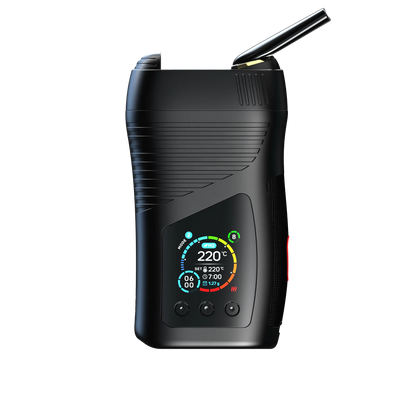
Wolkenkraft LIVE
Convection device with freely selectable temperature in 1-degree increments between 40 and 220 °C. Exactly the device profile that makes the ramp from section 9 possible in the first place: anyone who wants to target 180, 195, and 210 °C one after the other needs a scale, not steps. Because the heat comes through the airflow, the gradient in the filling described in section 7 is also lower.
View Wolkenkraft LIVE →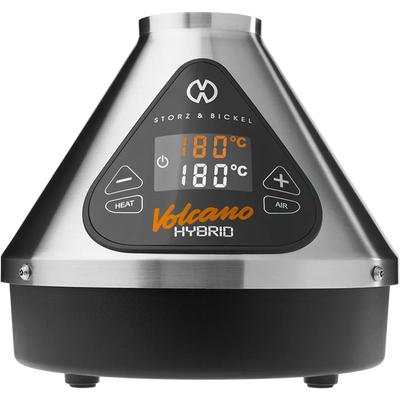
Volcano Hybrid (Storz & Bickel)
Tabletop device with stepless adjustment from 40 to 230 °C via touch display, optionally via app. The predecessor of this device series was the reference device for several of the studies cited above – including Hazekamp et al. and in the temperature series by Pomahacova et al. The balloon operation also decouples the draw strength from the vaporization, which largely eliminates the influence of the draw technique described in section 10.
View Volcano Hybrid →Fixed levels or fine adjustment via app
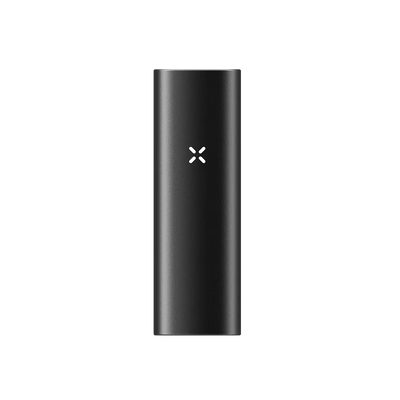
PAX Mini 2
Four fixed levels directly on the device: 180, 190, 200, and 215 °C. This gradation covers the core range described in Table 3 and can be increased during a session – the ramp from section 9 in simplified form, without having to choose a specific degree.
View PAX Mini 2 →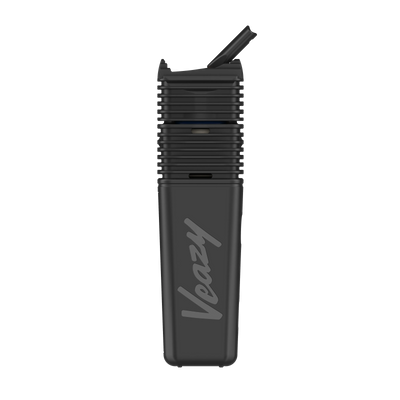
Veazy (Storz & Bickel)
Compact hybrid device operated with a few settings in everyday use and finely adjustable between 40 and 210 °C via web app. Practical for anyone who finds their setting once and then doesn’t want to think about it anymore – and a good way to test the difference between target and material temperature described in section 7 for your own device.
View Veazy →Sources
- Turovsky E. H., Moriarty K., Chavarria N., Parco J. E., Kachadourian R., Brasuel M. G. (2025): Application of thermogravimetric analysis (TGA) and differential scanning calorimetry (DSC) to estimate the normal boiling points of Δ⁹-tetrahydrocannabivarin (THCV) and Δ⁹-tetrahydrocannabinol (THC). Journal of Cannabis Research 8, Article 9. DOI: 10.1186/s42238-025-00373-w – Primary source for the normal pressure boiling point of Δ⁹-THC (245 ± 6 °C) and for classifying the 157 °C value as the distillation temperature at 0.05 Torr.
- Gieringer D. (2001): MAPS/NORML Study Shows Vaporizers Reduce Toxins in Marijuana Smoke. Bulletin of the Multidisciplinary Association for Psychedelic Studies (MAPS), Volume 11, No. 1. Classification: Pilot study, published in a professional society newsletter and not peer-reviewed – historically the first study of its kind on the Cannabis Vaporizer and therefore still the starting point of the scientific literature. Its core findings (first significant THC release from about 180 °C, elimination of benzene, toluene, and naphthalene) were confirmed three years later in the peer-reviewed work by the same author. Full text: MAPS Bulletin 11(1)
- Gieringer D., St. Laurent J., Goodrich S. (2004): Cannabis Vaporizer Combines Efficient Delivery of THC with Effective Suppression of Pyrolytic Compounds. Journal of Cannabis Therapeutics 4(1): 7–27. DOI: 10.1300/J175v04n01_02
- Pomahacova B., Van der Kooy F., Verpoorte R. (2009): Cannabis smoke condensate III: the cannabinoid content of vaporised Cannabis sativa. Inhalation Toxicology 21(13): 1108–1112. DOI: 10.3109/08958370902748559 – Primary source for the temperature series 170 / 200 / 230 °C.
- Lanz C., Mattsson J., Soydaner U., Brenneisen R. (2016): Medicinal Cannabis: In Vitro Validation of Vaporizers for the Smoke-Free Inhalation of Cannabis. PLoS ONE 11(1): e0147286. DOI: 10.1371/journal.pone.0147286 – Primary source for device comparison at 210 °C and decarboxylation rates.
- Wang M., Wang Y.-H., Avula B., Radwan M. M., Wanas A. S., van Antwerp J., Parcher J. F., ElSohly M. A., Khan I. A. (2016): Decarboxylation Study of Acidic Cannabinoids: A Novel Approach Using Ultra-High-Performance Supercritical Fluid Chromatography/Photodiode Array-Mass Spectrometry. Cannabis and Cannabinoid Research 1(1): 262–271. DOI: 10.1089/can.2016.0020 – Primary source for decarboxylation kinetics and activation energy.
- Hazekamp A., Ruhaak R., Zuurman L., van Gerven J., Verpoorte R. (2006): Evaluation of a vaporizing device (Volcano) for the pulmonary administration of tetrahydrocannabinol. Journal of Pharmaceutical Sciences 95(6): 1308–1317. DOI: 10.1002/jps.20574
- U.S. Department of Health and Human Services / Centers for Disease Control and Prevention, Office on Smoking and Health (2010): How Tobacco Smoke Causes Disease: The Biology and Behavioral Basis for Smoking-Attributable Disease. A Report of the Surgeon General, Chapter 3 "Chemistry and Toxicology of Cigarette Smoke." Official report from the US Department of Health, without involvement of the tobacco industry. Quote: "Temperatures reach 900 °C during a puff and fall to about 400 °C between puffs." Full text: NCBI Bookshelf, NBK53014. Confirmed by the National Cancer Institute monograph: Hoffmann D., Hoffmann I. (1998), Chemistry and Toxicology, in: Cigars: Health Effects and Trends, Smoking and Tobacco Control Monograph No. 9, NIH Publication 98-4302, with up to 910 °C in the glowing cone of a cigarette (PDF at NCI). Scale for size comparison between combustion and vaporization.
- PubChem, National Center for Biotechnology Information (NIH): Substance datasets with the respective associated pressure – α-Pinene (CID 6654), β-Myrcene (CID 31253), Limonene (CID 22311), Eucalyptol (CID 2758), Terpinolene (CID 11463), Linalool (CID 6549), β-Caryophyllene (CID 5281515), α-Humulene (CID 5281520). The boiling points listed there come from the CRC Handbook of Chemistry and Physics, The Merck Index, the Hazardous Substances Data Bank (HSDB), and the Human Metabolome Database (HMDB); for α-Humulene, only a value at 3 mmHg is available there, no normal pressure boiling point.
Note: This article serves as technical and scientific information about the functioning of vaporizers and does not make any statement about the consumption of specific substances. The use of vaporizers and handling of the mentioned substances are subject to the applicable legal regulations. All temperature and measurement values are reference values from the cited literature and may vary depending on the device, material, and measurement method. Statements about a more favorable ratio of active ingredients to by-products are comparative statements from the mentioned studies and do not imply health safety.


